The Arbitrage Engine: How Hedge Funds Secure Fixed Returns
Legal Disclaimer & Disclosure
This content is strictly for educational purposes. I am not a SEBI-registered Investment Adviser (RIA) or Research Analyst (RA). Nothing posted here should be construed as an offer to buy/sell or a recommendation of any security.
1. The Core Concept: The "Basis"
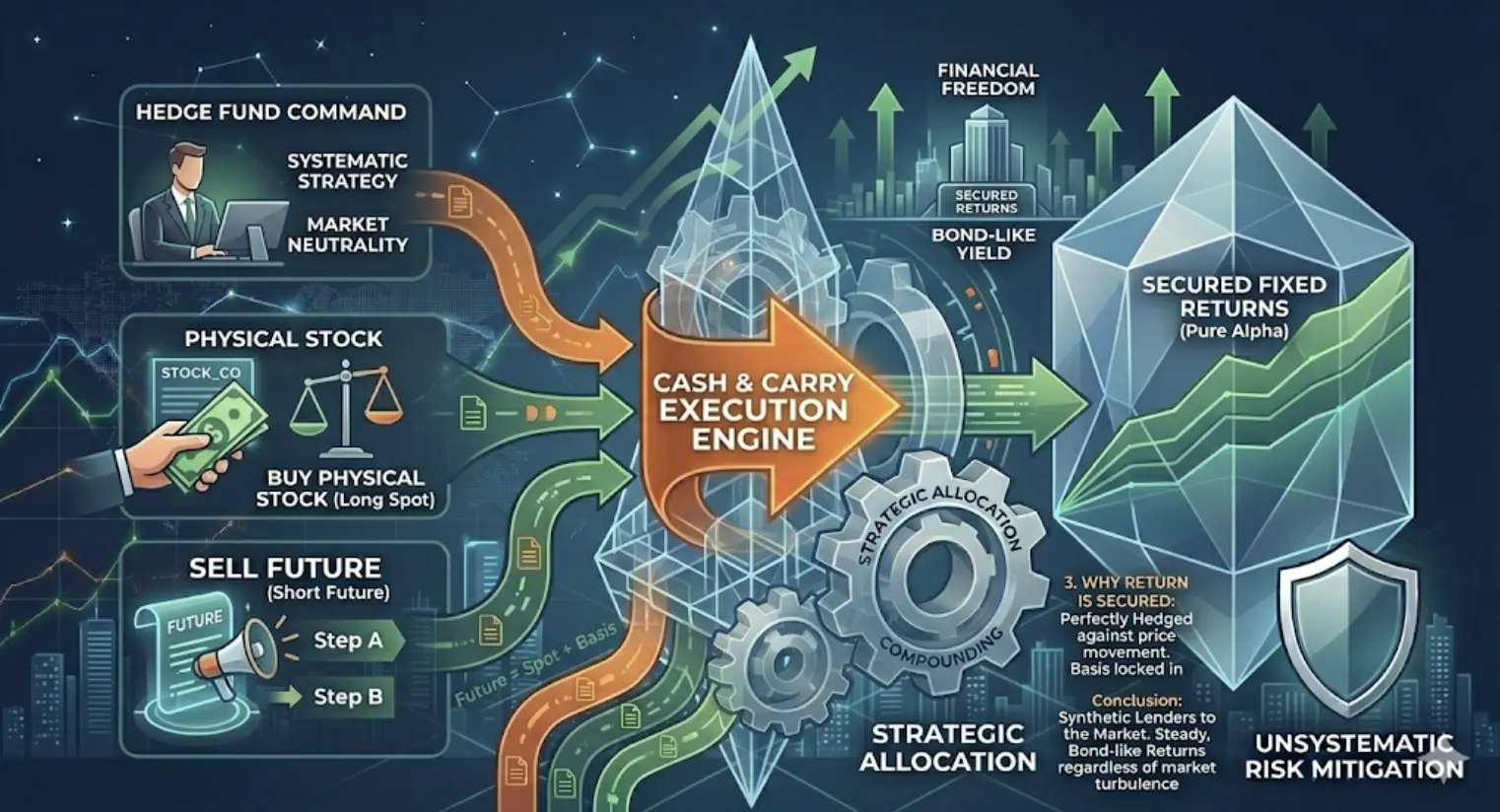
In a healthy market, a stock's Future is typically priced higher than its current Spot price. This difference is known as the "Basis," representing the cost of carry—interest rates minus dividends.
2. Step-by-Step Execution
- Step A: Buy the Physical Stock (Long Spot) - Purchase the asset in the cash market.
- Step B: Sell the Future (Short Future) - Simultaneously sell an equal value of futures contracts for the same asset.
- Step C: Convergence - Wait for the expiration date when the futures price and spot price mathematically must meet.
3. Why the Return is Secured
Because the fund is simultaneously long and short, they are perfectly hedged against price movement. Whether the stock rises or falls, the profit on one side offsets the loss on the other. The fund keeps the original spread (Basis) locked in at the start of the trade.
Comparison Summary
| Feature | Directional Trading | Cash & Carry Arbitrage |
|---|---|---|
| Market Outlook | Bullish or Bearish | Market Neutral |
| Primary Tool | Technical / Fundamental | Mathematical Basis Analysis |
| Risk | High (Price Volatility) | Very Low (Operational) |
| Return | Unlimited Potential | Fixed (Interest Equivalent) |
Conclusion
Hedge funds act as synthetic lenders to the market. By buying the asset and selling the promise of that asset in the future, they generate steady, bond-like returns regardless of market turbulence.